Over the years, I’ve developed numerous smaller tools that don’t deserve an extensive page, but that do deserve to be shared. These tools don’t have much in common other than 1) I wrote them, and 2) They might be of interest to an aerospace engineer.
libNeuralFoil
libNeuralFoil is a C++ library implementation of Peter Sharpe’s NeuralFoil. NeuralFoil is a neural network model of airfoil performance trained on a large set of XFoil runs. This library version of NeuralFoil is intended for tight integration into C++ programs without introducing a Python dependency on the resulting binary.
In addition to evaluating the NeuralFoil model, libNeuralFoil also has the ability to calculate the first derivatives of the NeuralFoil model – facilitating use in applications including optimization, iterative solution, and uncertainty propagation.
PropDBTools
The UIUC Propeller Data Site is a tremendous resource created and maintained by Prof. Michael Selig and students at UIUC. A large number of propellers suitable for application to radio-control aircraft and small UAV’s have been tested in the wind tunnel with the results reported in the data site.
While the propeller data (say $C_T$ and $C_P$ vs. $J$) is contained in simple data files, the meta-data for each propeller (say diameter, pitch, and what RPM’s were tested) is not explicitly provided. Instead, it is implied by the names of the files containing the data.
This layout style makes it very easy for a user to scan the database and to pull out the data they need about a particular propeller. Unfortunately, this style makes it rather challenging for a computer program to scan through and to work on the database as a whole.
These tools address that challenge. Originally written in Matlab, this has been ported to Python by Daniel Enriquez and is used under the hood in his online propeller database PropFolio.
MATPAN2D
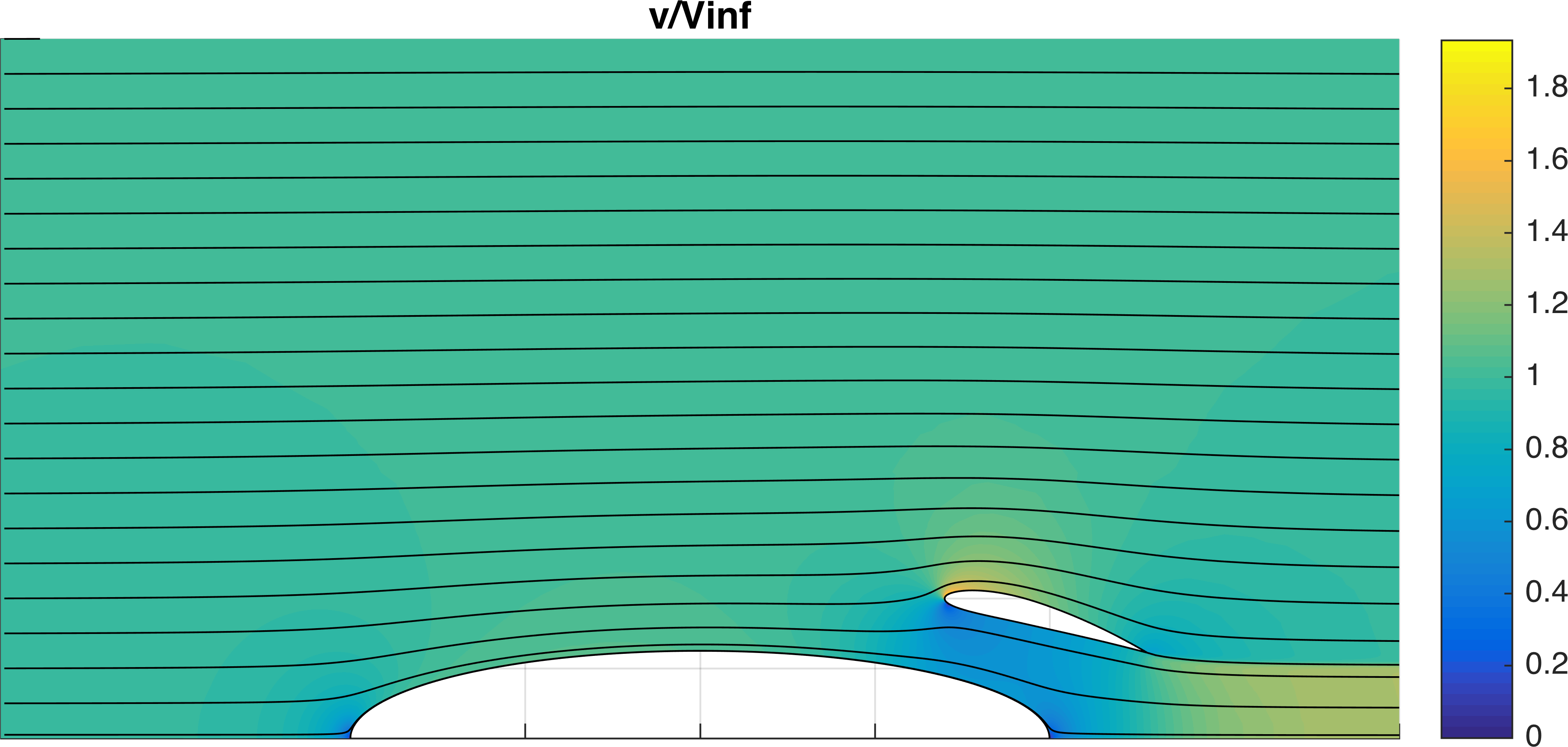
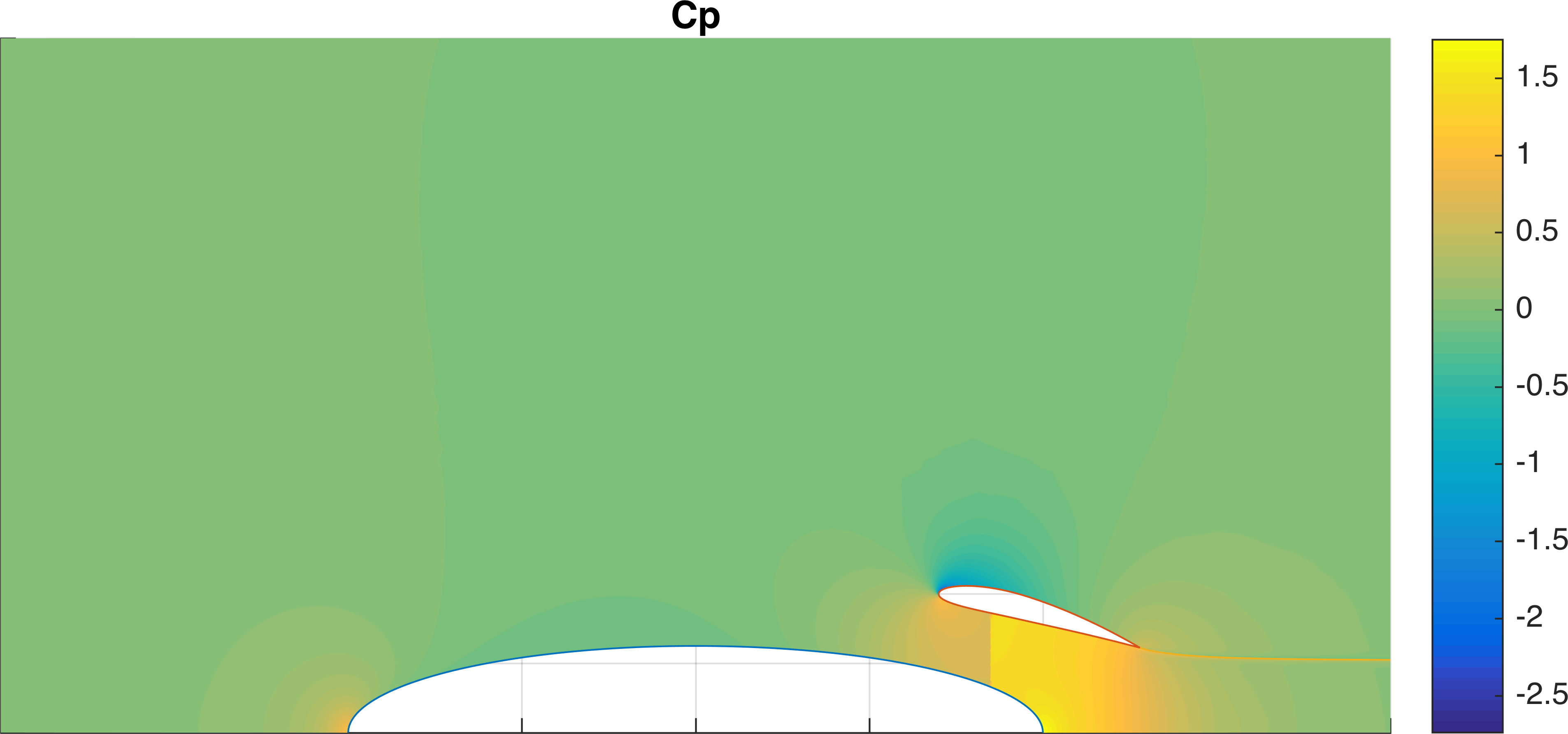
MATPAN2D is an attempt to create a fast, simple, and hackable design tool for modeling interesting aerodynamic phenemona including power-effects and inteference between bodies. It is intended to be a teaching and reference implementation — readable, documented, and verifiable. It is a 2D potential flow code capable of either planar or axisymmetric solutions based on the methods in Vortex Element Methods for fluid Dynamic Analysis of Engineering Systems, by R.I. Lewis, 1991.
bat-perf
bat-perf is a MATLAB implementation of a battery performance model appropriate for conceptual design and performance studies of aircraft. It is a very simple approach, but it captures the required nuance for this purpose.
In addition to the core battery model, bat-perf can also calculate specific energy knockdown factors - an interpretable set of metrics that quantify the non-ideal effects incurred when using a battery.
The ideas implemented in bat-perf were first published in Batteries Are Not Fuel. Formalism underpinning these ideas was later published as an AIAA Paper - bat-perf (or its predecessors) was used for all of the calculations in these articles.
CHTLS - Constrained Hermite Taylor Series Least Squares
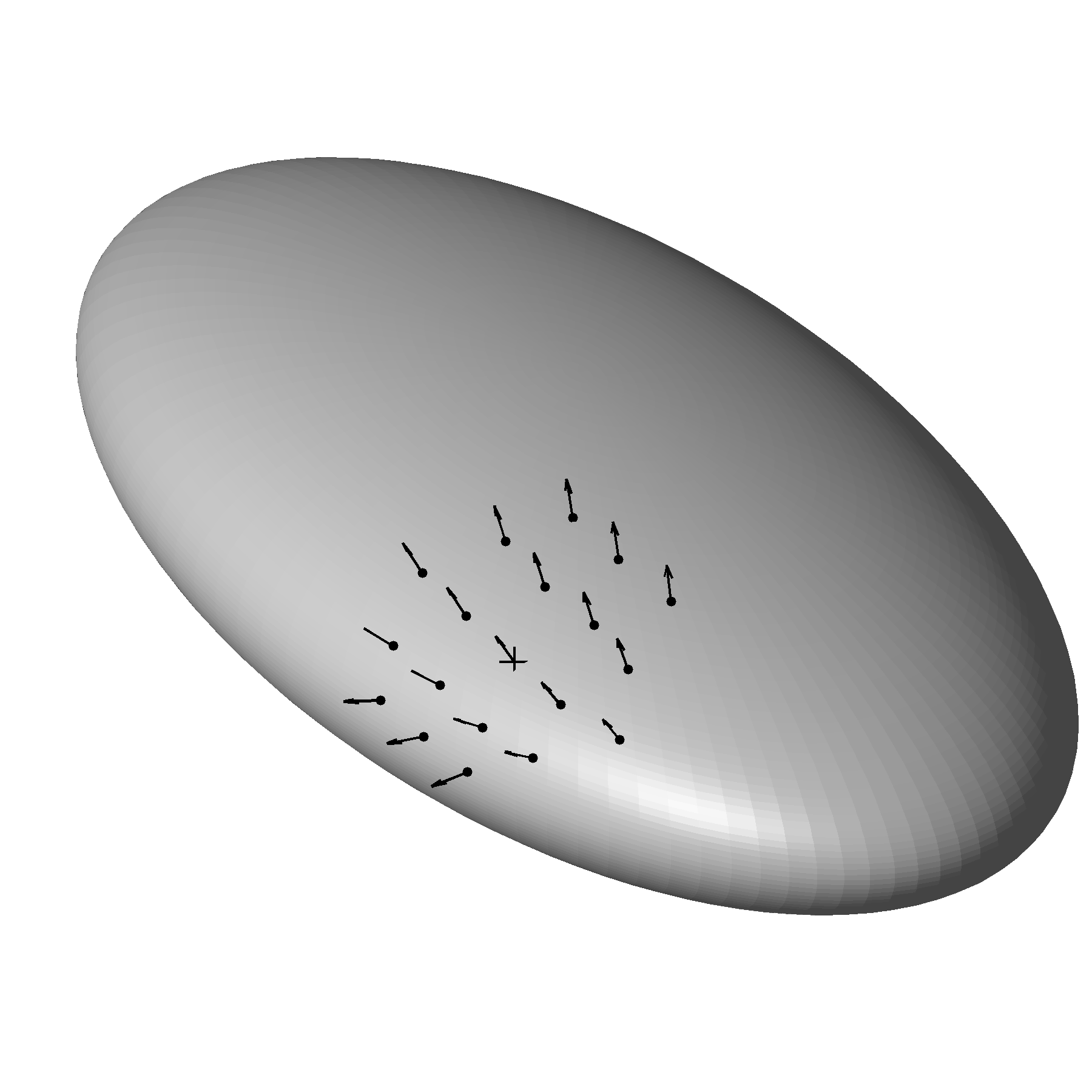
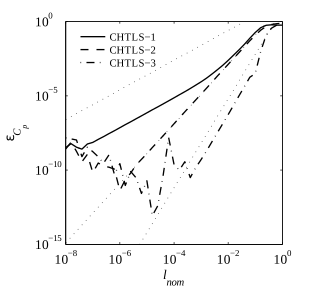
Like the finite difference method, the Taylor Series Least Squares method can be used to estimate derivatives. The TLS technique can be used to estimate derivatives from scattered or unstructured data. The Hermite Taylor Series Least Squares technique augments the TLS approach with information about the derivative of the function. The Constrained Hermite Taylor Series Least Squares technique augments the HTLS technique by constraining the least squares problem to match the derivative at the point of interest.
The CHTLS is capable of calculating surface velocities and thereby pressure from the potential solution in unstructured panel codes. It has been used for this purpose by multiple codes including VSPAERO, CPanel, DUST, and others.